May 26, 2026
This year’s annual delegation trip to Washington, D.C. brought together over 110 delegates joining forces to elevate a variety of regional priorities throughout a series of meetings with the new administration and congressional members. Conversations focused on critical issues including trade, the Tijuana River Valley pollution crisis, housing, defense, immigration, energy, and healthcare, amongst others.
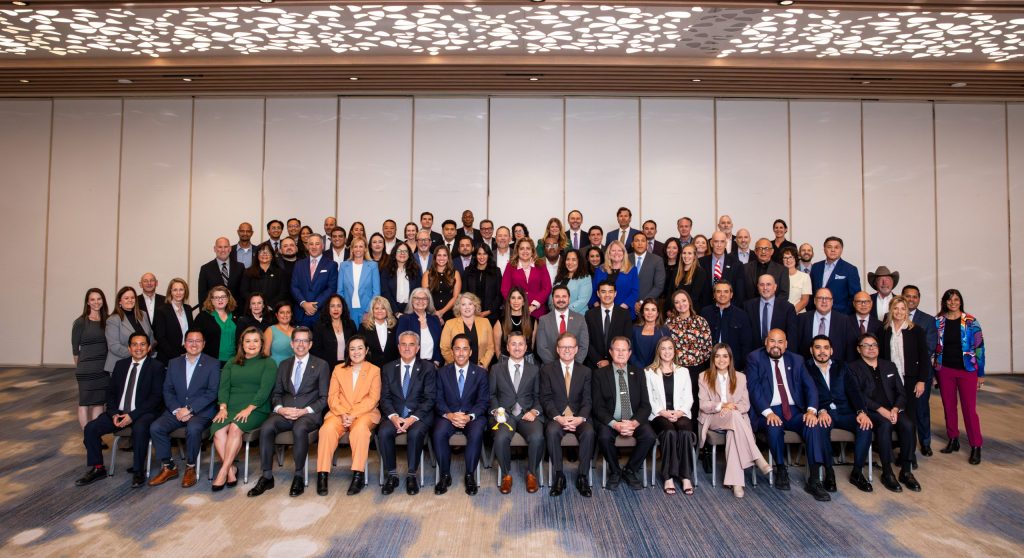
The 2026 Mission to Washington, D.C. delegation
We were joined by a diverse mix of leaders from the San Diego and Baja California region representing different industries, organizations, and publicly held offices including:
- San Diego Mayor Todd Gloria
- National City Mayor Ron Morrison
- Poway Mayor Steve Vaus
- Escondido Deputy Mayor Joe Garcia
- San Diego City Council President and SANDAG Vice Chair Joe La Cava
- San Diego Councilmembers Vivian Moreno, Kent Lee and Stephen Whitburn
- Imperial Beach Councilmember Mariko Nakawatase
- And Tijuana Councilmembers Gina Arana, Heriberto Ramirez, Michel Garcia, and Pablo Yañez.
Their active participation throughout the trip was critical to advance our region’s priorities including border efficiency, infrastructure investment, economic development and trade facilitating policies, mitigating transboundary pollution, healthcare policies, and innovation technology. We were encouraged by some wins and opportunities to raise concern about actions that would have a detrimental impact on our community.
On the trade and economic development front, delegates met with leadership from the Small Business Administration (SBA), Department of State, and other federal partners to discuss regional competitiveness, USMCA implementation, and the impacts of tariffs and trade uncertainty on businesses. Officials emphasized ongoing coordination with Mexico under President Sheinbaum’s administration to address security and economic concerns, while also acknowledging business concerns regarding USMCA rules of origin and visa processing backlogs. Delegates highlighted the need for continued outreach on trucker visa revocations and advocated for policies that support cross-border commerce and workforce mobility. The SBA also noted future involvement in the USMCA revision process and recognized San Diego’s strong collaboration with local small business leadership.
Infrastructure and transportation priorities remained central throughout the trip. Meetings with the Department of Transportation focused on federal funding opportunities for major regional projects, including the LOSSAN Corridor and other cross-border infrastructure initiatives, including Otay Mesa East Land Port of Entry. Federal officials emphasized a “back to basics” approach to grants and encouraged stronger alignment between infrastructure applications and national priorities, including the upcoming Los Angeles Olympics. Delegates also discussed the importance of expediting environmental review processes to move projects forward.
Healthcare discussions centered on the evolving federal funding environment and ongoing uncertainty surrounding healthcare policy. Delegates expressed concerns regarding the long-term outlook for NIH funding levels, the potential implications of future reconciliation packages, and the effects of federal budget negotiations on healthcare systems, research institutions, and biotech innovation. Conversations also addressed immigration challenges affecting healthcare workforce recruitment, including H-1B visa limitations and growing visa processing backlogs.
Immigration and workforce issues emerged as a recurring concern across sectors. Experts and stakeholders noted that immigration enforcement and visa delays are increasingly impacting employers and regional workforce stability. Delegates heard that visa backlogs have significantly increased due to enhanced security vetting procedures, creating uncertainty for businesses and institutions that rely on international talent, students, and skilled workers.
Delegates also continued advocating for urgent federal action to address the transboundary pollution crisis impacting the Tijuana River Valley. Throughout meetings with the EPA, Department of State, congressional offices, and the IBWC, delegates emphasized the importance of accelerating infrastructure improvements, strengthening binational coordination, and ensuring transparency and community engagement throughout the process. EPA and federal officials discussed ongoing coordination with Mexican counterparts, implementation of Minute 333, and efforts to improve monitoring and permitting processes. Delegates also reiterated the need for continued investment in water infrastructure and environmental restoration programs, elevating the Five-Pillar Framework Report that the Chamber released this past March.
Defense and national security conversations highlighted San Diego’s strategic role in innovation and military readiness. Meetings with Navy leadership included updates on the NAVWAR Old Town Campus revitalization project, partnerships supporting military housing and infrastructure, and new financing tools through the Office of Strategic Capital to scale critical technologies and supply chains. Discussions also underscored the growing national awareness around research, development, and defense innovation partnerships.
Additional meetings focused on housing affordability, energy policy, and federal appropriations. Housing officials discussed growing federal interest in factory-built housing and local best practices to address nationwide housing shortages amid inflationary and trade-related pressures. Energy discussions reflected the Administration’s focus on natural gas, critical minerals, advanced manufacturing tax credits, and emerging technologies such as nuclear fusion, while also signaling a gradual phaseout of certain renewable energy incentives. Delegates also received updates on the federal appropriations process, including continued delays in project approvals, challenges surrounding continuing resolutions, and the importance of demonstrating broad community support for funding requests. While we unfortunately were unable to meet with U.S. Customs and Border Protection leadership due to the temporary federal funding lapse, a follow-up meeting has been secured virtually with Executive Assistant Commissioner Donald Stakes on June 1st for delegates that joined us last month.
📸View Photo Album Here 📌 See full trip agenda
Statements from our delegates:
“This delegation is not a courtesy visit, it is a focused, high-impact effort to deliver real results for our region,” said Chris Cate, President and CEO at the San Diego Regional Chamber of Commerce. “The decisions made in Washington shape the trajectory of the San Diego region’s economy, our workforce, and our quality of life. We are here to advocate, both clearly and unapologetically, for federal policies, investments, and partnerships that strengthen our binational economy and champion business across our region.”
“Nothing makes as great an impact as meeting face-to-face with federal officials, sharing our common goals and building a bond of mutual respect,” said San Diego Council President Joe LaCava. “Our delegation is working for the people of San Diego and the cross-border region to make sure federal resources and funding are invested in our corner of the country and in our residents. ”
“This is not a symbolic action – it is a strategic move. Our economies are deeply interconnected, our communities are linked, and our future depends on collaboration,” said Tijuana Councilmember Lemuel Ramirez. “By participating in this delegation, we ensure that our voice is heard in spaces where key decisions are made and we can deliver results for our community – creating jobs, supporting businesses, and building a more competitive and prosperous region.”
“Over the past few years, leaders across business, philanthropy, community, and government have come together to pursue a lasting solution to the border sewage crisis in the San Diego–Tijuana region,” said Emily Young, Vice President of Programs, Prebys Foundation. “This is not just a regional challenge—it is a matter of national security, a threat to our binational economy, and a direct risk to the health and wellbeing of thousands of American families. It must be treated as a federal priority.”
🎙Watch the trip press conference here.